Today we went to the west bank of the Nile to visit the Valley of the Kings, the burial place for the rulers of Egypt.
We were up early and walked down to the Nile. Clear and beautiful, and not too hot. It would get warm later. That's the VotK right across the river.
 The view from our hotel room
 A white donkey -- Ahab-- Cynthia gets her shot
 This is in the visitors center for the Valley of the Kings. When you look at this from the other side it's the standard relief map of the valley, with the burial sites indicated. However, the fiberglass is thin, so when you go around to the other side you can see underground where they have shown the burial chambers for all of the kings. Hard to see in the picture, but I thought it was an excellent map.
 Your admission to the VotK includes three tombs. We just followed our guide to go to the three that she picked. We only had an hour, so we couldn't be too picky.
 We paid the extra $18 for the camera pass. My impressions: the tombs are much smaller than I had imagined, but amazingly brilliant after millennia. The paint is not redone, it's the original.


 We got there early, so the crowds weren't bad. We were able to get pictures inside the tombs without a lot of people in the way.
 A portion of the VotK. It was a much smaller area than I had imagined, with tombs located just 10s of meters apart, rather than the 100s I had imagined. One of the reasons that Tut's tomb was not robbed is that a later tomb, Ramses VI, was constructed just up the hill from Tut, and tons of spoil was placed on top of Tut's tomb. It took Howard Carter to actually find the tomb.


 We also paid the extra $12 for Tutankhamun's tomb. No photography was allowed inside, but it was worth the money. After a steep 30m descent into the outer chamber, the mummy of Tut was displayed. In the actual burial chamber the outer sarcophagus that you've all seen, was displayed.
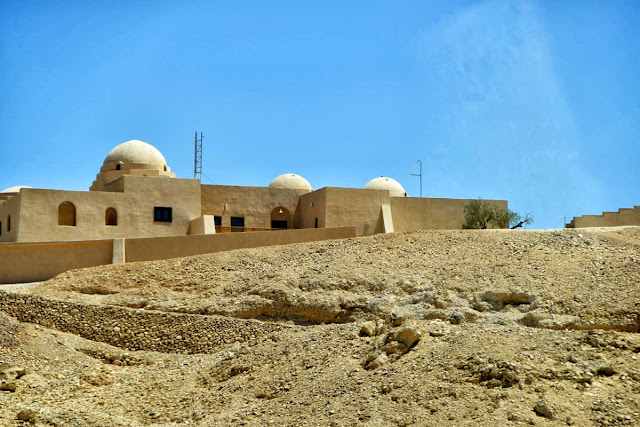
 Howard Carter's home, about a mile from the VotK.
 A photo stop at the Hatshepsut temple. We didn't take the mini-train to the temple.

 We did visit the Habu temple. This is where it got really hot. No air moving inside, with large areas of unshaded sun. The A/C bus felt very good after 30 minutes in Habu.

 One unexpected impression of the temples we visited: every vertical surface seems covered in pictures and writings. In Habu there was lots of "pharoah smites enemy" artwork. On one wall of the Luxor temple there was a table of numbers, a bunch of writing next to it, and finally pictographs for some story. Right there was the Egyptian equivalent of Microsoft Office -- Excel, Word and PowerPoint. What's the chance of your Microsoft document being readable in 5K years?
 The undersides of the arches have been well protected and the original color is still there.
 These are not tour guides, but rather an entire group dressed in period costumes celebrating the peak of British archeology and the discovery of Tut's tomb. It seemed way too hot for cosplay, but then Carter and company dressed like this when they were actually exploring.

 Colossi of Memnon
 As we returned to the hotel for lunch we recrossed the Nile. Next to the bridge (about 5km south of Luxor -- to go 2km from the hotel to the VotK we drove about 15km) were about 30 river boats tied up. Further down the river and into Luxor were another 30 or more. These ~200 passenger river boats, intended for multi-day cruises, were all mothballed. Apparently Nile cruising is in a recession.
 The first story of this house is occupied -- note the laundry. Supports and rebar are in place for a second story addition. According to our guide there are two reasons: the house isn't "finished" so the taxes are lower, and Muslim tradition has the eldest male children moving into their parent's house on the higher floors. So this house will be built upwards as the family requires.
 Fewer police checkpoints on the way back to the boat than the west bound trip. There were two completely separate roads for east and west bound traffic, separated by miles. The west bound checkpoints are more frequent and more heavily armed -- light machine guns mounted in observation towers overlooking the checkpoint.

We were up early and walked down to the Nile. Clear and beautiful, and not too hot. It would get warm later. That's the VotK right across the river.


