Feb 7 Luderitz
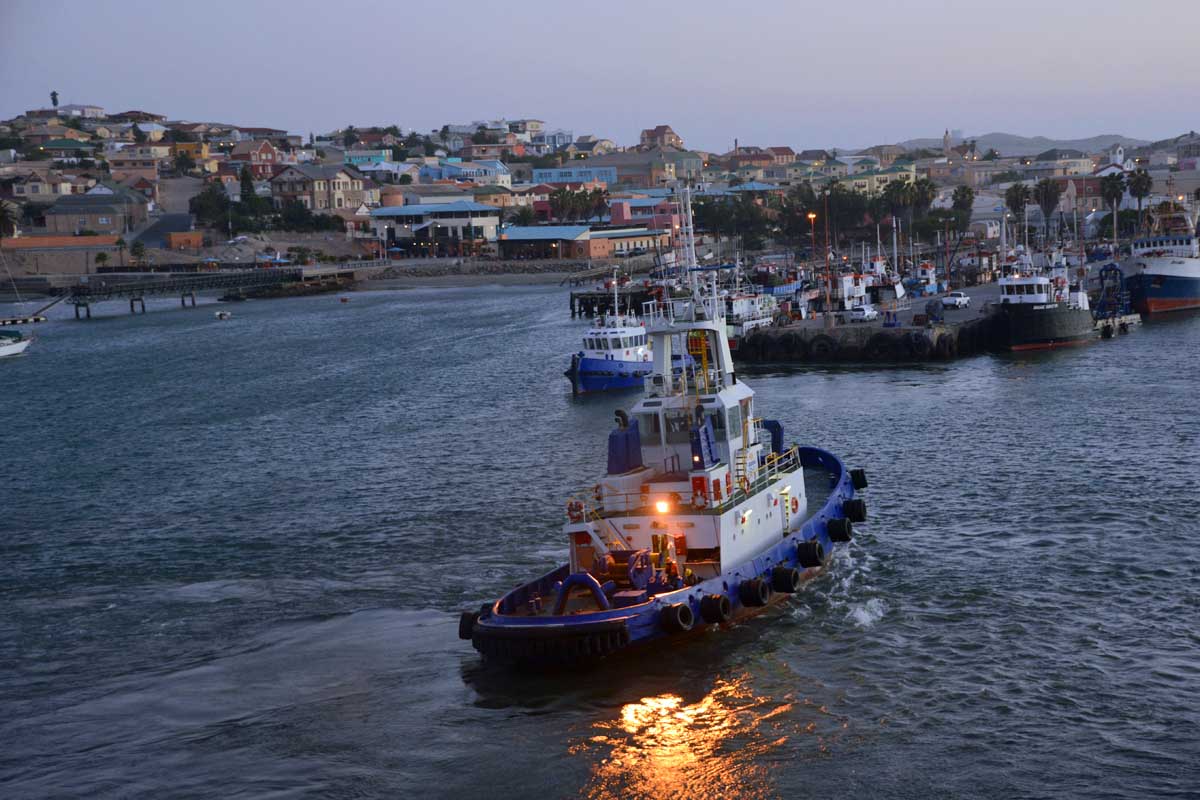
Our noon arrival into Luderitz bay was graceful and elegant. Instead of anchoring and forcing passengers to ride a tender across the bay in very high winds, the captain docked the ship with great panache. Arriving in the mouth of the bay he piroutted the ship within its length, and then slowly and carefully backed into position alongside the quay. The port is small and shallow -- based on all the muddy water churned up during our approach. A masterful job, and I appreciated avoiding the tender today and just walking down the gangway.
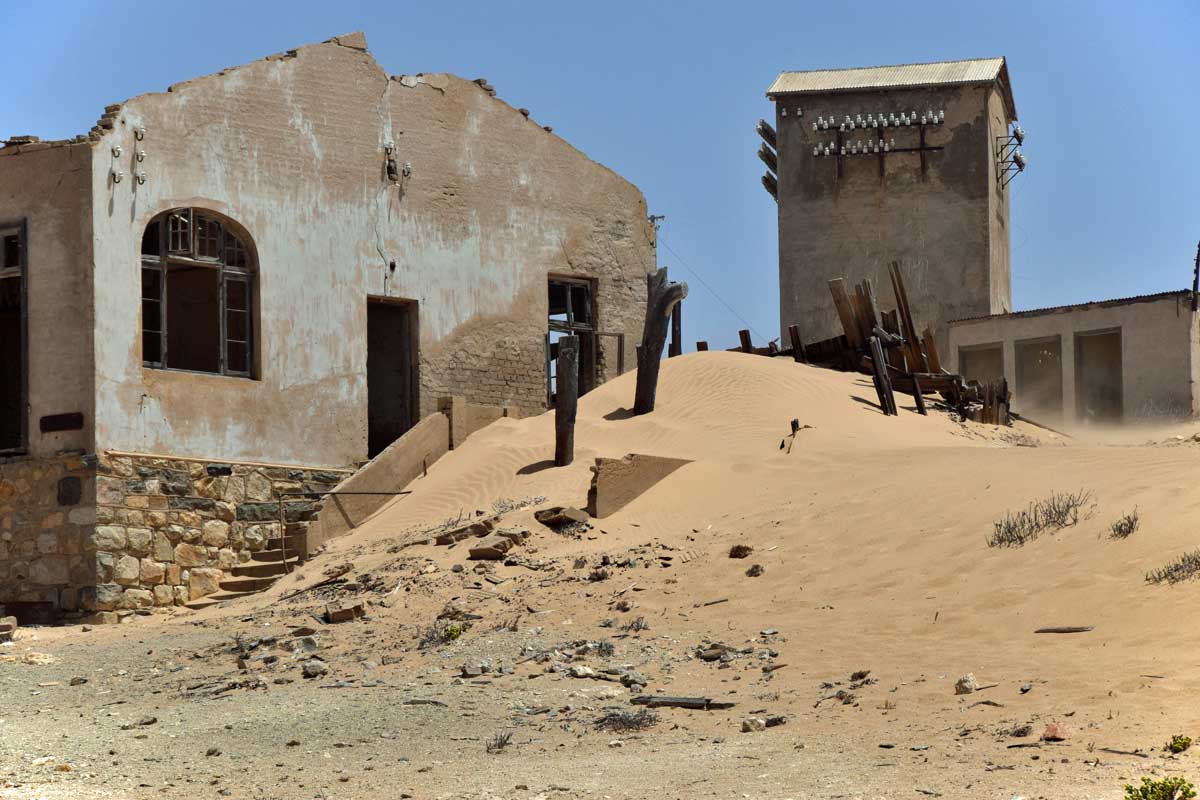
We opted for the Kolmanskop Ghost town tour, and after an early lunch joined our group for the 15 minute drive 6 miles inland to the town of Kolmanskop. Or rather, the abandoned buildings that had been the thriving mining town. After the discovery of diamonds in the dry river bed a town of German mining executives sprang into existence. During its lifetime it was the peak of society for its inhabitants. It wasn't a gold mining camp like the California '49ers of the US, but rather a German company town where everything was formal, disciplined and controlled.
The trick to life in southern Namibia was being able to put up with the howling winds and lack of rain that meant horizontal sand was part of everything you did, and in everything you owned. The collapse of the diamond market after WW I emptied the town quickly since the local climate discouraged any longtime dweller. It's now a ghost town, with many buildings still standing but slowly filling with and returning to the sand. Somewhat eerie, and definitely photogenic. And we're still trying the get the sand out of our ears -- and other places.
Needed a little help to get into position
Felsenkirche on Diamond Hill
Driving to Kolmanskop, wind and sand
Kolmanskop
Avoiding the blowing sand, or robbing the diamond mine?
Every house got 5 kilos of ice daily, made here
Felsenkirche
Sunday afternoon, the streets were empty. Must have been watching the Super Bowl
Feb 6 Walvis Bay
Goodbye to Angola. The flag comes down and goes into the flag locker until the next time Insignia comes by west Africa.
We chose the tour of the Namibian desert via off-road vehicle. But first it was the nearby lagoon to see the flamingoes. Lots of brine shrimp keep them happy and in the pink (pun intended). As people walked closer, the birds moved further away. Yet people kept trying to get closer. It was difficult to determine the bird brains in the two groups.
We're off towards Swakopmund and there are lots of dunes along the highway. Since 1900 the Wright brothers, gliding down sand dunes in windy spots near the ocean has always been a fun thing to do.
Into
Dorob National Park and we entered a moonscape. Plants are few and far
between,rain comes at the rate of 15mm per year, and dusty rocks are
everywhere. We need Greg Wheeler here to translate all of this --
although our driver Lawrence pointed out that most of this was granite,
with some veins of marble and dolomite within. One group of rocks was
particularly rich in iron, and when a guide banged a small rock into a
big rock, it sounded like a bell sounding a note. Apparently some
musician has been here and recorded a song using the different rocks.
The
black streak running across the top of this ridge is dolomite, which is
harder and therefore erodes more slowly than the lighter colored
granite, leaving a dark stripe along the top. In the next picture you
can see the veins of pink marble within the granite. And next you can
see the folding that occurred when this area was still very hot and
soft. Looks very pretty now.
A unique plant in the desert is the Welwitschia mirabilis, referred to as a "living fossil" since it has remained unhanged for the last 200 million years. And it just seems to grow that slowly. The bugs crawling around on the fruity part are essential to the pollination of the plants. The plants secrete a flavorful substance for these bugs and they travel the tens of meters from one plant to the next to get the goodies, taking pollen along with them.
Going back to the ship we passed the back side of the dunes, and stopped at Dune 7 (since it's seven miles from the ocean). Some tried to climb up the slope, but quickly tired in the very soft sand. And there's no value in climbing it, since the people who scooted down on their bottoms complained of how hot the sand was -- to say nothing of all the places the sand probably ended up.
In the afternoon back aboard there was a special presentation by the Makato Chorus. Think "Glee" in West Africa without show tunes but with African rhythm. A couple of the performers were both good singers and expressive performers. It was a wonderful performance. They sold CDs to further fund their activities and they left the ship with a fistful of dollars and handfuls of cookies from the Insignia bakery. A good time was had by all as they sung us away from the dock.
Feb 3 Luanda
We were unsure about Angola and Luanda. The civil war was not long ago, we had heard that they were not hospitable to tourists, and Oceania even said that we would have "escorts" and not "guides" on the shore excursions.
Our stop in Angola turned out to be delightful. We chose a short excursion, Panoramic Luanda, that was scheduled to visit 3 cultural sites in the city. Our escort turned out to be more of a guide, whose English was very good. The two 40-passenger buses that comprised our group were escorted by a motorcycle policeman who whisked us through traffic and red lights. We had no difficulties at all.
We stopped first at the Nazare Church, built in 1664 by a governor who survived a shipwreck and arrived at this location. The Portugese heritage was clear in the beautiful tiles the covered the church walls.
Stop number two was the colonial fort that now housed the Museum of the Armed Forces. Here again there were Portugese tiles on the walls, but the views from the fortress walls were the best. Everywhere you looked, Luanda was growing, construction cranes outlined the sky. Luanda is the most expensive place to live in the world, outpacing Tokyo, New York and London. But if our guide Andreas is any indication, the people are happy to be here.
That's the Mausoleum in the distance
The last stop was for the Mausoleum for the first president of Angola who led them into independence. It's an amazing structure, looking like a Soviet rocket on the launch pad. And there are other touches of the Soviet influence around the building, especially the statuary around the crypt.
After a tour out to the beaches it was back to the ship.
We really didn't see much of the city and the country. We stayed within a couple of miles of the port, and didn't stray far from the water. We did go past a large area of slums that Andreas said were being demolished and the people relocated. But we had seen slums and the very poor in Togo and Benin, probably worse than those in Angola. So our fears were without foundation. We had a good time, saw the local sites and enjoyed it. We probably won't be coming back to Angola anytime soon, but there's no reason not to.... dave
Monday, February 1, 2016
Sao Tome; an island nation off the coast of Gabon
Today is again overcast, thankfully, as it is quite warm since we are very close to the equator.
There had been several shore excursions offered earlier in the year, but many of those were plantation tours and they have all since closed, except for one that has reopened, just to show tourists how coffee production was done.
It was a tender port. Lifeboats away.
Sitting on the dock next to our tender landing spot...MG-B
Motorcycles are the primary transport
We had chosen to go on a waterfall and bird watching tour and we boarded a small van to begin our tour about 1/2 hr late. The tenders were very busy transporting the majority of passengers into port but we figured the waterfall had been there for a while and the birds didn't care!
Coffee beans on the tree
A stop at the Botanical Gardens up in the hills ~3800', where it was cooler
According to our guide there are few jobs in Sao Tome so the unemployment rate is over 70%. Most of the people we saw on our way to the waterfall appeared to be clear cutting small areas of the jungle and planting vegetables for market stalls and personal use.
Birds were mostly heard and seldom seen
The waterfall is lovely, the roads were pretty bad as soon as we left the port area, and the birds, while heard, weren't interesting in showing off to us.
I'm glad I saw Sao Tome but if I don't return here again, it will be okay....c